
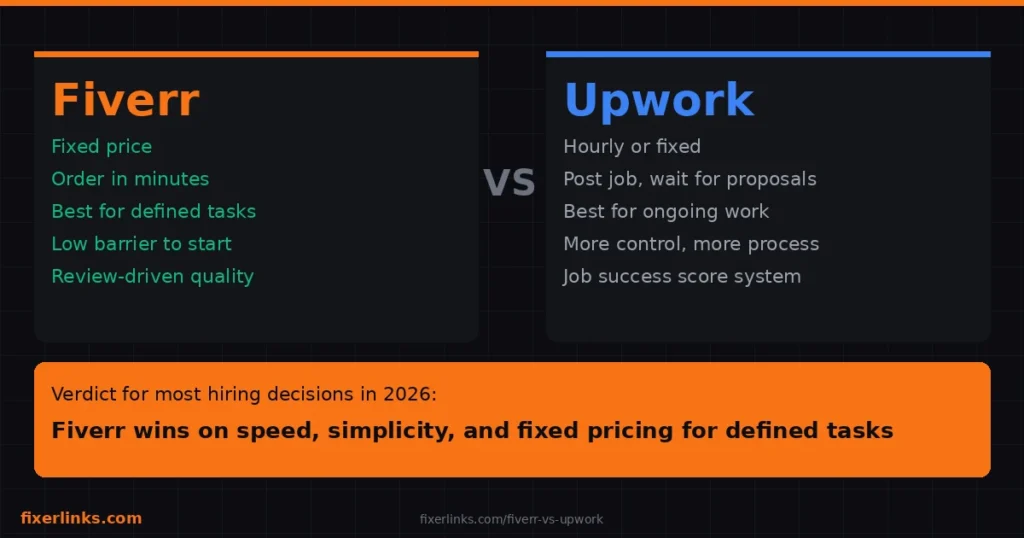
- Fiverr is better for defined, one-time tasks with a fixed price and fast turnaround
- Upwork is better for ongoing work, larger projects, and hourly contracts
- Fiverr is faster to get started — no proposals, no interviews, just order
- Upwork has more overhead but gives you more control on complex long-term projects
- For most people hiring for websites, design, SEO, or digital tasks — Fiverr wins on speed and value
Two platforms. Millions of freelancers. One decision. So lets discuss Fiverr vs Upwork? Which one you should choose?
If you’ve spent any time trying to hire someone online, you’ve seen both names. Fiverr and Upwork dominate the freelance marketplace space and they both have real talent on them. But they work very differently — and picking the wrong one for your project wastes time and money.
I’m a Level 2 seller on Fiverr and I’ve hired through both platforms. This isn’t a sponsored comparison. It’s the honest breakdown of what each platform actually does well and when you should use one over the other.
How Each Platform Actually Works
Before comparing them, you need to understand the fundamental difference in how they’re built.
Fiverr works like a shop. Sellers list their services with fixed prices and defined packages. You browse, find what you need, and order — sometimes without even messaging the seller first. The seller delivers. You review. Simple.
Upwork works like a job board. You post what you need, freelancers send proposals, you review applications, interview candidates, and then hire. Payment can be hourly or fixed price but the process always involves back-and-forth before any work starts.
That difference in structure changes everything — the speed, the pricing, the type of work each platform suits, and the kind of experience you’ll have as a buyer.
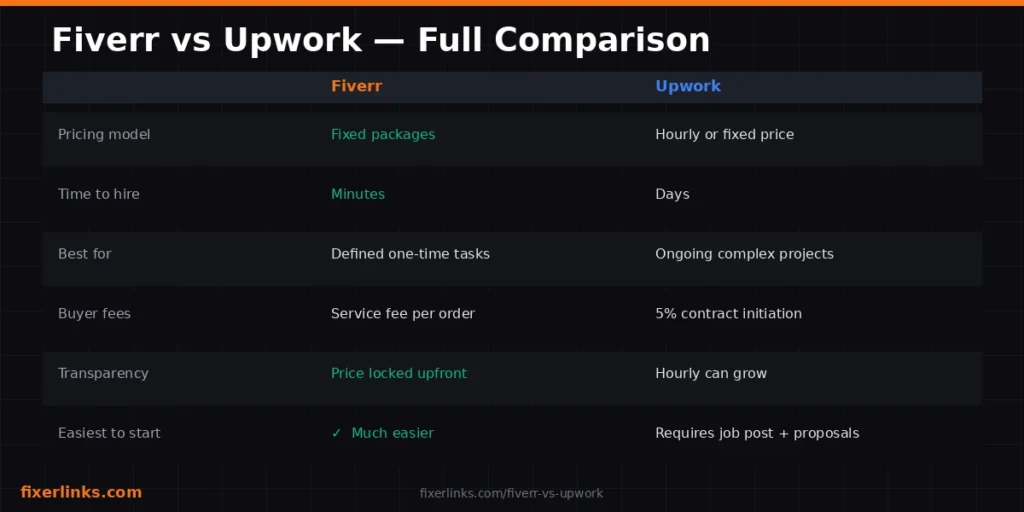
Head to Head — The Full Comparison
| Fiverr | Upwork | |
|---|---|---|
| Pricing model | Fixed packages | Hourly or fixed price |
| Getting started | Order immediately | Post job, wait for proposals |
| Time to hire | Minutes | Days |
| Best for | Defined tasks, one-time projects | Ongoing work, complex projects |
| Fees (buyer) | Service fee on each order | 5% contract initiation fee |
| Fees (seller) | 20% on first $500 with a buyer | 20% up to $500, then lower |
| Talent pool | Global specialists | Global specialists |
| Quality control | Reviews + Pro vetting | Reviews + Top Rated badges |
| Dispute resolution | Fiverr mediation | Upwork mediation |
| Minimum spend | As low as $5 | No hard minimum |
Where Fiverr Wins
Speed. On Fiverr you can go from searching to ordered in under ten minutes. No job posting, no waiting for proposals, no interview process. When you know what you need — a logo, a Shopify setup, a speed optimisation — Fiverr gets you there faster than any other platform.
Fixed pricing. You know exactly what you’re paying before you commit. No hourly rate surprises, no scope creep billed by the hour. The package tells you what’s included and the price is locked.
Defined deliverables. Fiverr works best when there’s a clear output. A logo file. A built Shopify store. An SEO-optimised set of product pages. Twenty product descriptions. When you can describe what done looks like, Fiverr delivers it efficiently.
Low barrier to start. No contract negotiation. No onboarding calls. No back and forth before work begins. A seller with 300 reviews has already proven themselves to 300 people — you’re not taking a risk, you’re reading evidence.
Motivation to deliver. As I’ve written before, Fiverr’s review system creates sellers who genuinely want to make you happy. Their entire ranking and visibility depends on it. That’s not nothing.
Where Upwork Wins
Upwork isn’t worse — it’s different. And for certain situations it’s clearly the better choice.
Ongoing work. If you need a developer working 20 hours a week for three months, Upwork’s hourly contract structure is built for that. Fiverr’s package model isn’t designed for long-term retainer relationships.
Complex projects. When you’re not entirely sure what you need — when the scope is fuzzy and you need someone to help define it — the proposal and interview process on Upwork actually helps. You’re hiring a collaborator, not ordering a deliverable.
Larger budgets. Upwork tends to attract more senior freelancers for enterprise-level projects. If you’re spending $5,000+ on a custom build and need someone with deep strategic involvement, Upwork’s talent pool at that level is strong.
Hourly tracking. Upwork has a built-in time tracker with screenshots that logs hours worked. For clients who want visibility into how time is being spent, that’s genuinely useful.
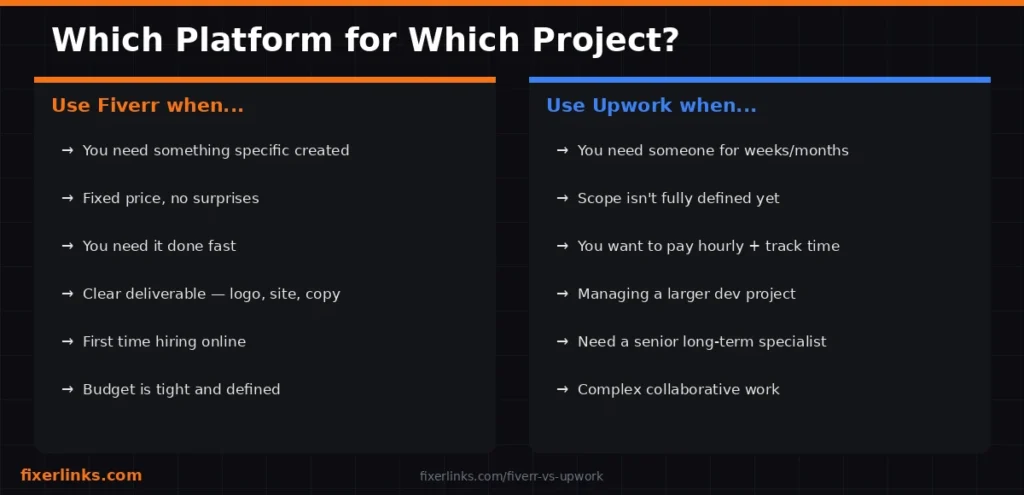
Which Platform for Which Project
Here’s the practical breakdown. Stop overthinking the platforms — think about the project type.
Use Fiverr when:
- You need something specific built or created
- You want a fixed price with no surprises
- You need it done fast
- The deliverable is clear — a logo, a website, a set of descriptions, an SEO audit
- You’re hiring for the first time and want low risk
Use Upwork when:
- You need someone for more than a few weeks
- The scope isn’t fully defined yet
- You want to pay hourly and track time
- You’re managing a larger development project
- You need a specialist for an ongoing retainer
For most people reading this — entrepreneurs launching stores, bloggers needing help, business owners outsourcing digital tasks — Fiverr covers 80% of what you’ll ever need to hire for. Faster, cheaper, and with less back-and-forth.
The Honest Take on Pricing
People assume Upwork is more expensive. That’s not quite right.
Upwork lets you post a job and hire at whatever rate you negotiate. You can find affordable freelancers on Upwork too. The difference is that Upwork’s hourly model makes costs harder to predict. A fixed-price project scoped at $200 can quietly become $400 if the freelancer logs more hours than planned.
Fiverr’s fixed package model protects you from that. What you see is what you pay. Revisions are capped, scope is defined, price is locked.
For anyone watching their budget closely — which is most people hiring for the first time — Fiverr’s pricing transparency is a real advantage.
What About Quality?
Both platforms have excellent freelancers and bad ones. The platform doesn’t determine quality — your vetting process does.
On Fiverr: check review count, check portfolio, message before ordering. A Level 2 seller with 200+ reviews is highly unlikely to disappoint.
On Upwork: check their job success score, read client feedback, look at how long they’ve been on the platform. A Top Rated freelancer with 90%+ job success across 50+ contracts is a safe hire.
The vetting signals are different but the principle is the same on both platforms — evidence of past performance is the only reliable guide to future performance.
The Verdict
For most hiring decisions in 2026 — Fiverr.
If you need a defined task completed at a fixed price by a specialist with a proven track record, Fiverr is faster, simpler, and better value than Upwork for that use case.
Upwork earns its place for long-term engagements, complex collaborative projects, and senior-level work billed hourly. But those are less common hiring scenarios for most people.
The mistake most people make is treating this as an either/or identity decision. Use both when it makes sense. For quick, defined work — Fiverr. For ongoing, complex work — Upwork.
Most of the time, that means Fiverr.
Find a Vetted Fiverr Specialist
Looking for a trusted freelancer without the research? I’ve put together a curated list of vetted Fiverr specialists across Shopify, WordPress, SEO, design, and more → fixerlinks.com/find-an-expert/
Need Shopify, WordPress, or affiliate system work? I handle that on Fiverr myself → fiverr.com/mayantharandunu
Frequently Asked Questions
Is Fiverr or Upwork better for beginners?
Fiverr is much easier to start with. You browse sellers, read reviews, and order — no job posting, no proposals, no waiting. Upwork requires more time upfront to write a job description, review applications, and interview candidates. For a first-time hire, Fiverr gets you results faster with less confusion.
Is Upwork more expensive than Fiverr?
Not necessarily, but it’s harder to predict costs. Upwork’s hourly billing means a $300 project can quietly become $500 if the scope expands. Fiverr’s fixed package pricing tells you exactly what you’re paying before you commit. For budget-conscious hiring, Fiverr’s transparency is a real advantage.
Can you find the same quality freelancers on both platforms?
Yes. Both platforms have excellent and poor-quality freelancers. The platform doesn’t determine quality — your vetting process does. On Fiverr, check review count and portfolio. On Upwork, check job success score and client history. High performers exist on both.
Is Fiverr good for long-term projects?
Fiverr works best for defined, deliverable tasks. For ongoing work — weekly development, monthly SEO retainers, continuous content creation — Upwork’s contract structure and hourly tracking are better suited. Most one-time projects are faster and simpler on Fiverr.
Which platform takes a bigger cut from freelancers?
Both platforms charge sellers 20% on earnings up to $500 with a new client, dropping to 10% after that. The rates are similar. The difference is that Fiverr also charges buyers a service fee per order, while Upwork charges buyers a 5% contract initiation fee. Neither is dramatically cheaper for buyers.
Can I use both Fiverr and Upwork?
Absolutely — and that’s actually the smart approach. Use Fiverr for quick, defined tasks where speed and fixed pricing matter. Use Upwork for longer engagements or projects where you need more collaboration. Treating them as complementary rather than competing saves time and gets you the right tool for each job.