
How to Rank on ChatGPT in 2026? Is this really important?
Something changed about how people search — and most small business owners have not noticed yet.
Your potential customers are no longer just typing into Google. They are opening ChatGPT and asking it a question the same way they would ask a trusted friend. “What is the best way to find a freelance designer for my startup?” “Which project management tool should a small team use?” “Who should I hire to fix my website?”
And ChatGPT gives them an answer. A real answer. With names, recommendations, and reasons.
The businesses that appear in those answers are getting customers. The ones that do not exist are invisible.
This guide shows you exactly how to get your business into those answers — step by step, in plain English, without hiring an agency or needing a technical background.
And if you want a printable checklist of every step, download the free PDF at the bottom of this page.
Summary
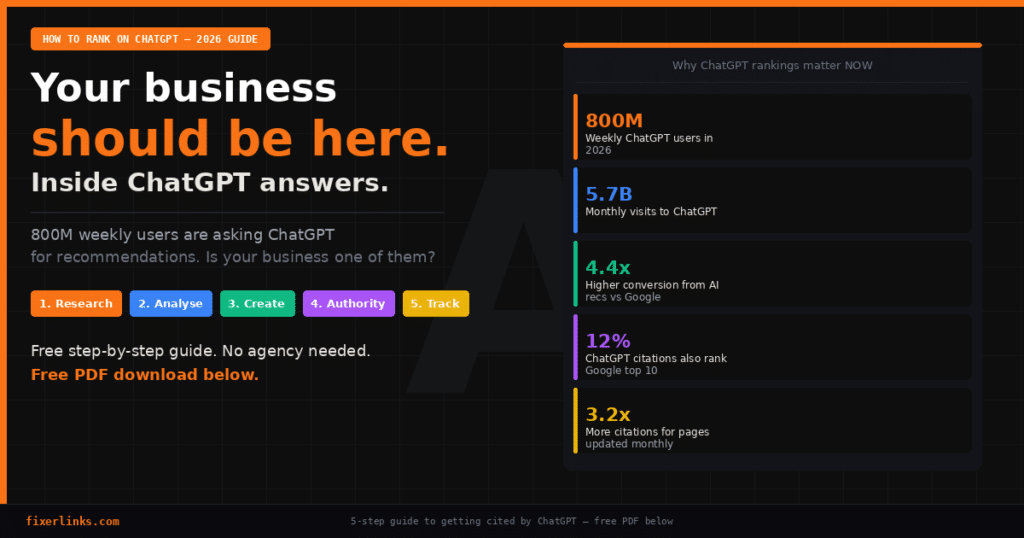
- ChatGPT has 800 million weekly users and generates 5.7 billion monthly visits
- Only 12% of URLs ChatGPT cites also rank in Google’s top 10 — different rules apply
- There are 5 steps to rank on ChatGPT: Prompt Research, Results Analysis, Content Creation, Authority Building, and Tracking
- The biggest difference from Google SEO: ChatGPT rewards direct answers, structured content, and external credibility over keywords
- You can start today with no budget and no technical skills
Why Ranking on ChatGPT Is Now a Business Priority
Let me give you the number that should make you stop what you are doing.
ChatGPT has 800 million weekly active users. That number doubled in eight months. It generates more than 5.7 billion visits every month. And according to research from Bain and Company, 80% of consumers now use AI-generated answers for at least 40% of their searches.
Your customers are in there. They are asking about businesses like yours. And right now, someone else is getting recommended instead of you.
Here is the part that makes this genuinely exciting for small business owners: the rules are completely different from Google. You do not need to have ranked on page one for years. You do not need a massive backlink profile. A 2026 Status Labs analysis found that only 12% of URLs that ChatGPT cites actually rank in Google’s top 10. That means an established small business with good credibility signals can appear in ChatGPT recommendations even if they have never won at traditional SEO.
The door is open. You just need to know how to walk through it.
How ChatGPT Actually Decides Who to Recommend
Before we get into the steps, you need to understand one thing: ChatGPT is not a search engine. It does not rank pages in order. It does not have a position one through ten.
When someone asks ChatGPT a question, it does something more like what a well-read advisor would do. It draws on everything it has been trained on, plus real-time web browsing when enabled, and it synthesises an answer. If your business is well documented, trustworthy, and clearly relevant to the question, it gets woven into that answer. If you are not well documented, you simply do not exist to ChatGPT.
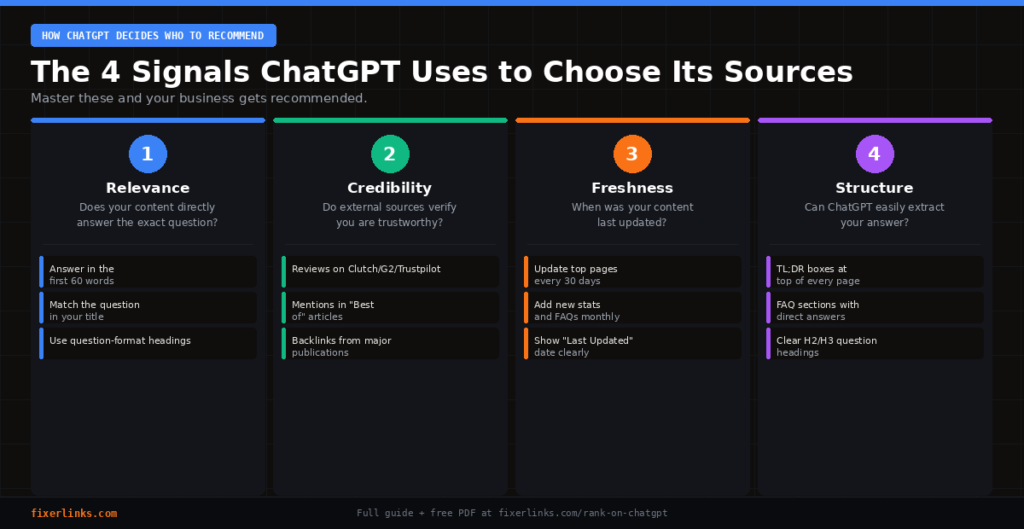
The four things ChatGPT considers when deciding whether to cite a source are:
Relevance — Does this source directly and clearly answer the question?
Credibility — Are there external signals that this business or source is trustworthy? Reviews, third-party mentions, industry recognition?
Freshness — Has this content been updated recently? Pages updated in the last 30 days are cited 3.2 times more than stale pages.
Structure — Is this content formatted in a way that is easy to extract? Clear headings, direct answers, FAQ sections?
Now let’s go through exactly how to optimise for all four.
Step 1: Prompt Research – Find Out What Your Customers Are Actually Asking
The first thing you need to do is stop guessing and start listening. Not to Google’s keyword tool, but to ChatGPT itself.
Your customers are not typing two-word searches into ChatGPT. They are asking full questions, the way they would ask a friend. “What is the best freelance platform for a first-time client?” “How do I know if a freelancer is reliable?” “Who are the best people to hire for a small business website redesign?”
These are the prompts you need to identify and optimise for.
How to do it:
Open ChatGPT and type: “What are the most common questions small business owners ask when looking for [your service or product]?”
ChatGPT will generate a list of real questions. These are the prompts your customers are already using. Write them all down.
Then do something that most businesses never think to do — test those prompts yourself. Type each one into ChatGPT and see what comes back. Who gets recommended? What businesses or websites appear? What does ChatGPT say about them?
These cited businesses are your AI search competitors. They might be completely different from your Google competitors. Study them. What do they have that you do not?
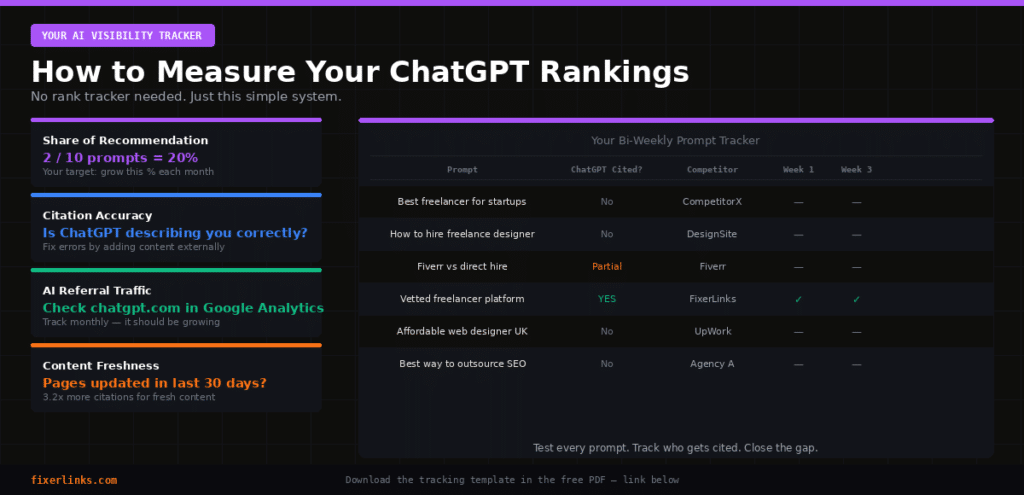
Build a simple tracking spreadsheet. Ten prompts down the left side. Columns for: Who was cited? Was your business mentioned? What position in the answer? Test this every two weeks. This is how you measure progress in AI search — not rankings, but citation rate.
Step 2: Results Analysis – Study What Is Already Working and Why
Now that you know who ChatGPT is recommending instead of you, it is time to figure out exactly why.
The most important thing to look for is external validation. ChatGPT builds trust the same way a human would — by checking what other people say about you. If Clutch, Trustpilot, Forbes, and three industry directories all mention your competitor, ChatGPT sees that business as established and trustworthy. If you are only mentioned on your own website, ChatGPT has nothing to verify you against.
What to look for when analysing cited competitors:
Search Google for “best [your service type] 2026” and “top [your industry] companies.” The websites that appear in those lists — review platforms, industry directories, major publications — are the exact sources ChatGPT trusts. Make a list of every directory and platform where your competitors appear but you do not.
Look at the content structure of cited businesses. Are their pages long or short? Do they have FAQ sections? Do they use clear headings that are phrased as questions? Do they include specific statistics and numbers?
Check if your industry has a Wikipedia page that mentions specific companies. ChatGPT cites Wikipedia in nearly half of its top responses. If your competitors appear in a Wikipedia article about your industry and you do not, that is a significant gap.
Finally, look for the content your competitors have not written yet. The questions in your prompt list that nobody is answering well are your fastest route to being the one ChatGPT cites.
Step 3: Create Content That ChatGPT Can Extract and Quote
This is where the real work happens — and where most businesses get it completely wrong.
They write content for human readers without thinking about how AI extracts it. ChatGPT does not read your beautifully crafted introduction and appreciate the tone. It scans for the fastest, clearest, most directly useful answer to the question. A page that buries its main point three paragraphs in will get skipped in favour of a page that answers immediately.
Here is the content formula that consistently gets cited:
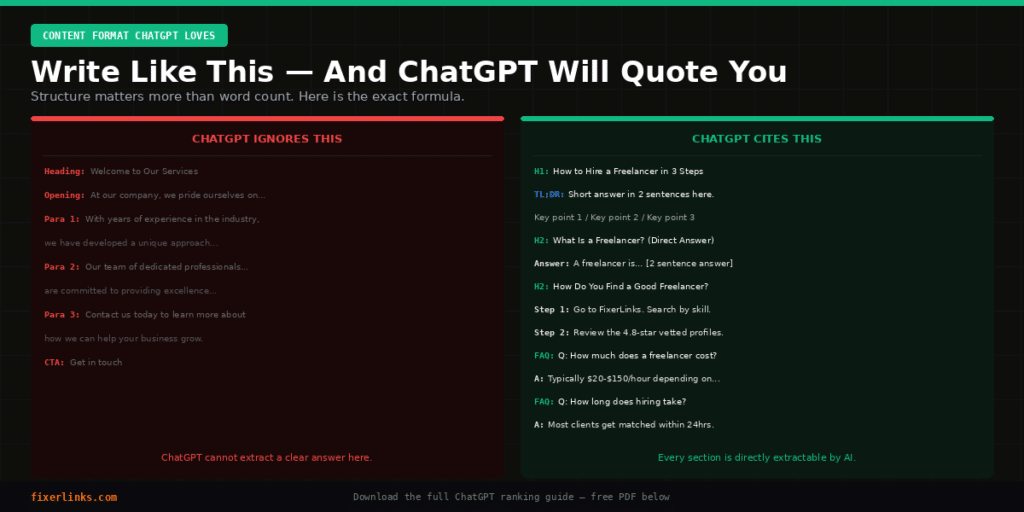
Lead with the direct answer. Every page should open with a 2-3 sentence direct answer to the question in the title, before any context or introduction. “A freelancer brief is a one-page document that explains your project goals, timeline, and budget. Here is exactly how to write one that gets great applications.” That is a citable opening. Three paragraphs about the history of freelancing is not.
Add a TL;DR box to every page over 800 words. Immediately after your H1 heading, add a box containing three to five bullet points summarising the key takeaways. Label it “Quick Summary” or “TL;DR.” AI tools frequently pull these directly into their answers. This single change can increase your citation rate significantly.
Format your headings as questions. Instead of “Our Process,” write “How Do We Match You With the Right Freelancer?” Question-formatted headings match the conversational queries ChatGPT searches for. They also improve your Google featured snippet performance at the same time.
Add FAQ sections to every important page. At the bottom of each key page, write five to eight questions your customers commonly ask — with direct, two to four sentence answers. FAQ sections are among the most-cited content formats in ChatGPT responses. They take thirty minutes to write and work indefinitely.
Use specific numbers everywhere. “Most clients see results” is not citable. “87% of clients who use a structured brief report getting better freelancer applications” is highly citable. AI tools prefer specificity because it makes their answers more useful. Add real numbers wherever you can, even if they are from your own experience.
Want to Learn More About Technical SEO – Technical SEO Checklist : Best Fixes to Rank High
Create comparison and recommendation pages. ChatGPT gets asked comparison questions constantly. “X vs Y” and “Best alternatives to X” pages align perfectly with how people use AI search. Build these pages for the most common comparisons in your industry.
Update your top pages every 30 days. Content freshness is one of the most powerful signals in AI citation selection. Set a monthly reminder to add a new section, update a statistic, or expand an FAQ on your five most important pages.
Step 4: Build the Authority That Makes ChatGPT Trust You
Great content alone is not enough. ChatGPT is cautious. It needs external evidence that your business is real, established, and genuinely worth recommending. This evidence comes from the places other people talk about you — not from your own website.
Think about it from ChatGPT’s perspective. If it recommends your business to someone and you turn out to be unreliable or not as advertised, that reflects on ChatGPT. So it checks. It looks for reviews, external mentions, third-party listings, and recognition from sources it already trusts.
The authority signals that matter most for ChatGPT:
Review platform presence. Clutch, G2, Trustpilot, Yelp, Google Business Profile. ChatGPT uses these as trust verification. A business with 40 reviews on Trustpilot is dramatically more citable than one with no external reviews. Claim every free profile this week.
“Best of” list appearances. When an established website includes you in “The 10 Best Freelancer Platforms in 2026,” that is one of the strongest authority signals available. Find articles in your space that list your competitors. Email the author. Offer to be included, and provide a strong reason — a unique angle, a testimonial, a piece of original data.
High-authority backlinks. Industry publications, local newspapers, government directories, Chamber of Commerce listings. One backlink from a major publication carries more weight for AI citation than fifty links from unknown directories. Write guest posts, offer expert commentary, pitch stories to journalists.
Brand mentions across the web. Podcast appearances. LinkedIn articles. Quotes in newsletters. Reddit or Quora answers. Every time your business name is associated with your topic on an external platform, ChatGPT becomes slightly more aware of who you are. This is called building your “brand mention footprint” and it compounds over time.
Complete and consistent business information everywhere. Your business name, address, phone number, website, and description should be identical across every platform where you appear. Inconsistencies confuse AI verification systems and reduce your trust score.
Step 5: Track Your AI Visibility and Keep Improving
Here is the thing nobody tells you about AI search optimisation: you cannot track it the same way you track Google rankings.
There is no position one. You are either cited or you are not. Your goal is to be cited in as many of your target prompts as possible, as often as possible, with accurate and positive descriptions.
The metric you care about is called Share of Recommendation — out of all the prompts your customers use, what percentage result in ChatGPT mentioning your business? If you are tracking 10 prompts and ChatGPT mentions you in 2 of them, your Share of Recommendation is 20%. Grow that number each month.
Your tracking routine:
Every two weeks, test all ten of your tracked prompts in ChatGPT and Perplexity. Record who was cited, whether you were mentioned, and what the description said. Update your spreadsheet. Look for patterns — are there prompt types where you never appear? Those are your next content priorities.
In Google Analytics 4, check your traffic from chatgpt.com, perplexity.ai, and claude.ai under Traffic Acquisition. This traffic is growing across the web. Track it separately so you can see the trend.
Every month, update your top five pages. Freshness matters enormously. Even a small update — a new statistic, a new FAQ question, an expanded section — resets the freshness signal.
Every quarter, go back through all five steps. The prompts your customers use change. New competitors appear. ChatGPT’s preferences evolve as its training data is updated. The businesses that will own AI search long-term are the ones that treat it as an ongoing system, not a one-time task.
The One Thing Most Businesses Get Wrong About ChatGPT SEO
There is a shortcut that seems obvious but does not work: stuffing your website with keywords and hoping ChatGPT picks them up.
ChatGPT is not a keyword-matching engine. It does not count how many times you say “best freelancer platform” on your homepage. It evaluates whether you genuinely understand the topic, whether external sources trust you, and whether your content is structured in a way that directly helps the person asking.
This actually levels the playing field for small businesses in a meaningful way. A large company with a mediocre, keyword-stuffed website can be outranked in ChatGPT by a smaller, genuinely helpful, well-documented business. The AI is looking for quality and credibility — and those are things any business can build with the right approach.
The businesses that will win AI search over the next three years are the ones starting right now. The ones that build their content infrastructure, claim their review platform profiles, get into industry articles, and update their pages regularly. Not because AI is magic, but because this is what being a genuinely authoritative and helpful business looks like — and AI is just getting better at recognising it.
Want to learn more about on-page SEO fundamentals – SEO Cluster 2026 – 5 Pillars Website Owners should Know
Frequently Asked Questions
How long does it take to rank on ChatGPT? Faster than Google in some cases. Because ChatGPT uses real-time web browsing when enabled, a well-structured page with strong external signals can be cited within weeks of being published. Some businesses see their first ChatGPT citations within 30 days of following this framework. Others take 90 days. Consistency matters more than speed.
Do I need to do anything technical to rank on ChatGPT? The content and authority steps require no technical skills. Adding FAQ schema markup to your pages does require either a plugin (RankMath makes this one click in WordPress) or a developer. But the biggest wins — prompt research, content restructuring, review profile setup, and outreach for “best of” mentions — require no technical knowledge at all.
Does traditional SEO still matter if I focus on ChatGPT? Yes. ChatGPT SEO and Google SEO reinforce each other. Many of the same signals matter for both — quality content, external credibility, structured data. Optimising for ChatGPT will also improve your Google performance, particularly for featured snippets and People Also Ask boxes. They are not competing strategies.
How is ranking on ChatGPT different from Google AEO? AEO (Answer Engine Optimisation) is the broader practice of optimising for any AI answer engine — including ChatGPT, Perplexity, Google AI Overviews, and others. Ranking on ChatGPT specifically means building the kind of documented authority and structured content that ChatGPT’s retrieval system values. The principles are similar across platforms, but each has slightly different citation preferences.
What is GEO and how does it relate to this? GEO (Generative Engine Optimisation) is the practice of becoming a source that AI systems cite in their generated answers. Everything in this guide is GEO. You are optimising not to appear in a ranked list, but to be woven into AI-generated answers as a trusted source. GEO is the umbrella that AEO, ChatGPT optimisation, and Perplexity optimisation all sit under.
Can I hire someone to do this for me? Yes — and for some steps like outreach campaigns, content restructuring, and schema implementation, hiring a specialist is faster and more effective. Visit fixerlinks.com for free matching with vetted freelancers who specialise in exactly this kind of work.
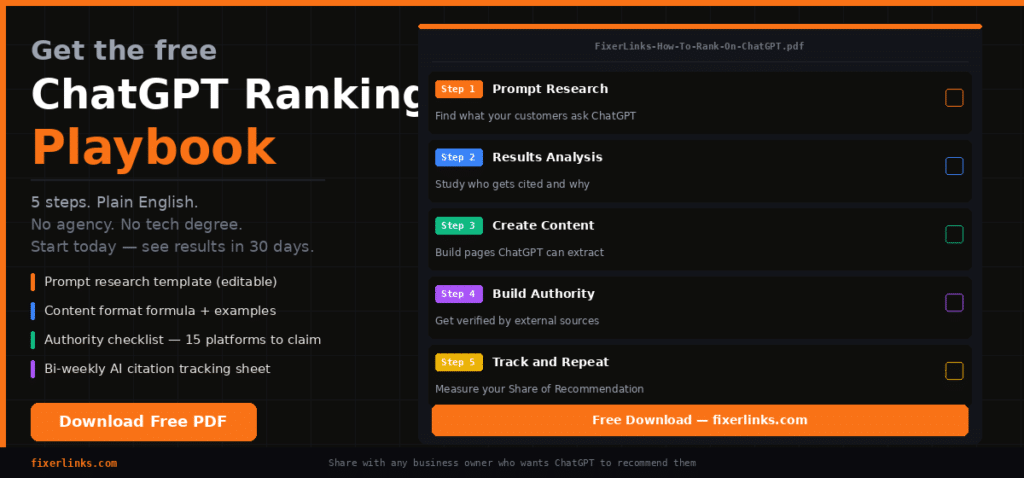
Download the Free PDF Checklist
Every step in this guide is available as a printable PDF with checkboxes for every single action.
Five steps. Plain English. No jargon. Print it, check the boxes, and start building your AI search presence today.
Need Help With Any of These Steps?
Some parts of this process are faster with expert help — content restructuring, schema markup, outreach campaigns, review generation. FixerLinks matches you with vetted, 4.8-star freelancers for any task in this guide.
NEED TO LEARN MORE ABOUT SEO? 100-Day SEO Plan for Website Business Owners 2026
Visit fixerlinks.com and describe what you need. Free matching, no commitment.
Written by FixerLinks.com — free freelancer matching for small business owners. We help you find the right person for the right job, at a price that makes sense for a small business.